

On this page
Arizona Pixel Lab uses schema markup for AI to turn a business website’s visible claims into explicit, machine-readable signals about its entity, services, locations, and content. Clean structured data helps search engines and AI answer systems connect what you offer, where you operate, and which page can credibly support an answer.
Table of contents
- What does schema markup for AI actually do?
- How does an AI system actually use structured data?
- How should you choose schema markup for AI visibility?
- Which core schema types should every serious business evaluate?
- Which properties carry the most weight, type by type?
- Which content schema helps AI systems find answer-worthy pages?
- How do AI citations differ from traditional rich snippets?
- How do you implement and validate schema markup for AI without spam?
- Frequently asked questions
What does schema markup for AI actually do?
Schema markup for AI gives machines a defined meaning for the people, businesses, services, places, products, and answers already published on your site.
Structured data is machine-readable code that labels the meaning and relationship of visible page content. Instead of forcing a system to infer whether “emergency plumbing” is a service, a heading, or a stray phrase, structured data can identify it as a service offered by a specific business in a defined service area.
That distinction matters. Search engines and AI answer systems process huge volumes of inconsistent pages. A clean data layer reduces ambiguity by making the relationships between facts easier to interpret. It gives an AI system a more direct path from an entity to its website, services, locations, authors, and supporting content.
Schema markup provides explicit semantic structure that helps machines - search crawlers and large language models alike - understand, classify, and display web content. Google's structured data documentation is the reference for which types exist and what each one means. A large language model (LLM) is an AI system that interprets and generates language by identifying patterns and relationships in information.
Schema does not magically make a weak page authoritative. It does not guarantee a ranking, a rich display, or an AI citation. It does make the factual structure of a strong page far easier to interpret, which is the practical purpose of structured data.
Be wary of anyone selling you a citation multiplier for schema. There is no credible public study that isolates markup as the cause of AI citations, and the ones circulating on agency blogs tend to be small samples with no control for the far more obvious variable: sites that implement schema carefully are usually sites that do everything else carefully too. Clean schema supports visibility when your site also has clear copy, accurate business information, fast delivery, and content that answers the real question. It does not substitute for any of them.
AI search is not a future project. Pew Research Center, working from the real browsing of 900 US adults, found an AI-generated summary on 18% of Google searches in March 2025. If your website is still a vague digital brochure, you are handing clearer competitors an avoidable advantage. Read our breakdown of how AI search really works to see why clear entities and direct answers matter.
How does an AI system actually use structured data?
Structured data feeds an entity graph - an organised model of things and the relationships between them - which a retrieval system can query far more reliably than it can re-read prose every time.
Without markup, a language model is parsing raw text and inferring connections. Those inferences are where errors come from: a model that was never told which of three addresses on your site is yours will pick one. Grounding retrieval in explicit relationships removes that class of guessing entirely, which matters most when the entity being described is your business and the cost of a wrong answer lands on you.
The practical consequence is that markup does not push you up a list. It makes you findable as a thing rather than as a string of matching words. When a system needs a business that offers a specific service in a specific city, an explicit graph is the difference between being a candidate and being invisible.
Microsoft has been public on the same point: Fabrice Canel, Principal Product Manager on Bing, has said schema markup helps Microsoft's language models understand page content, and that Copilot draws on structured data when interpreting a page. Accurate structure gives multiple search and answer systems a clearer version of your business. Sloppy structure gives them a reason to move on.
How should you choose schema markup for AI visibility?
Choose schema markup for AI by matching the markup to the page’s real job, not by adding every schema type you can find.
The wrong approach is schema stuffing: piling unrelated labels onto a page in the hope that more code means more visibility. It creates conflicts, makes maintenance harder, and signals that your data cannot be trusted. The right approach maps one primary page purpose to the most useful structured-data type, then connects related entities only where the visible content supports them.
Use this decision framework:
| Page or business reality | Best primary markup focus | Add only if the page visibly supports it | Decision criteria that matter |
|---|---|---|---|
| Your company identity and brand information | Organization | Logo, contact details, social profiles, brand description | Use sitewide data that stays consistent across the business |
| A physical or locally served business | LocalBusiness | Address, phone, hours, service area, parent organization | Use location-specific facts; do not copy one location’s details across every city page |
| A page explaining an offer | Service | Provider, service area, audience, related location | Use when the service is clearly described on the page, not merely listed in navigation |
| A guide, insight, or original resource | Article | Author, publisher, date information, main image | Use when the page is editorial content with a distinct topic and visible byline or publisher context |
| A direct question-and-answer page | FAQPage | Organization or Service where relevant | Use only for questions and answers displayed to visitors on that page |
| A process users can follow | HowTo | Relevant tools, materials, or steps shown on the page | Use only when the page genuinely presents a complete step-by-step method |
| A product detail page | Product | Offer, review, aggregate rating | Use only for a specific product and claims you can support visibly |
Start with the business entity, then build outward from that foundation.
For an Arizona company, that usually means connecting the organization to its primary website, then connecting each genuine location to its specific local business data, then tying service pages to the provider and service area. A business that serves Mesa, Chandler, Scottsdale, and Tempe should not publish interchangeable city pages with swapped place names. Each location page needs local proof, useful local context, and markup that reflects the page - not a template pretending to be local.
That is why a smart Google AI Overviews content strategy combines technical structure with credible service and location pages. Schema reinforces relevance and helps clarify what is already true. It cannot manufacture it.
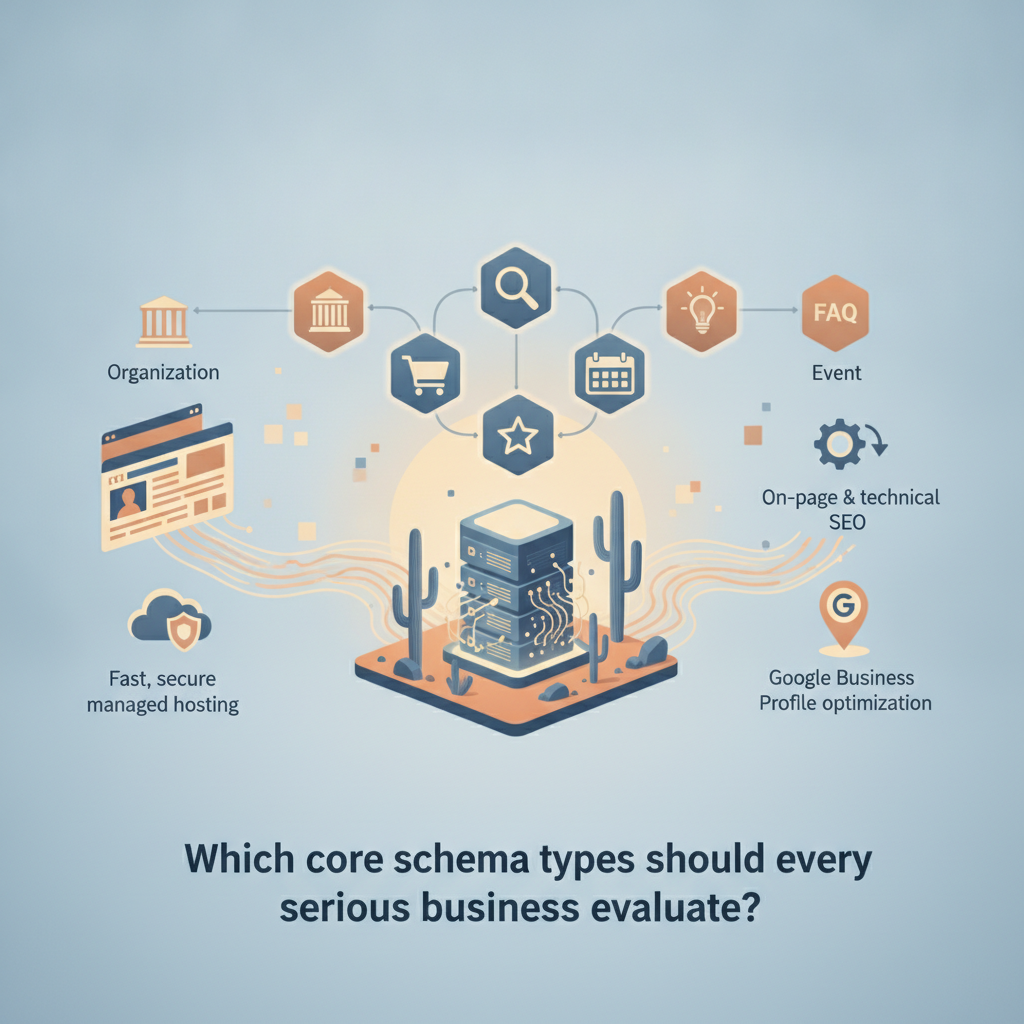
Which core schema types should every serious business evaluate?
Most serious businesses should evaluate Organization, LocalBusiness, Service, and WebSite markup first because these types clarify the commercial identity behind the site.
Organization defines the company-level entity: its name, website, logo, and other public identity details. Think of it as the business record that helps connect every legitimate page back to the same company.
LocalBusiness represents a business location or local operation. Use it where the page visibly presents location-level facts such as business name, address, phone, operating hours, or service area. A local business should not claim an address it does not publicly use or an area it does not actually serve.
Service identifies a service offer and can connect that offer to the company providing it and the area it serves. The service page still needs to do the heavy lifting: explain the scope, buyer problem, process, outcomes, and limitations in plain language. A label without useful copy is dead weight.
WebSite establishes the website as a distinct digital property associated with the business. It supports a cleaner entity foundation, particularly when paired consistently with Organization data.
A practical relationship may look like this in JSON-LD, the code format generally recommended for structured data implementation:
{
  "@context": "https://schema.org",
  "@graph": [
    {
      "@type": "Organization",
      "@id": "https://example.com/#organization",
      "name": "Example Business",
      "url": "https://example.com/"
    },
    {
      "@type": "Service",
      "name": "Managed Website Hosting",
      "provider": {
        "@id": "https://example.com/#organization"
      },
      "areaServed": "Arizona"
    }
  ]
}
The important mechanism is the shared identifier. The @id lets related blocks refer to the same organization instead of describing disconnected versions of the business. Replace every placeholder with facts visible on the relevant page. Do not paste this template into production and call it strategy.
Google's structured data documentation recommends JSON-LD, and the practical reason is that it creates a clean data layer systems can process without tangling structured facts up in page design. For most businesses, JSON-LD is the cleanest implementation choice because structured data can be managed separately from visual layout.
Which properties carry the most weight, type by type?
Choosing a type is half the work. The properties you populate are what actually carry meaning, and a type declared with two fields is barely worth declaring.
| Schema type | What it establishes | Properties that do the work | What it changes for your business |
|---|---|---|---|
Organization & LocalBusiness | Your company as a defined entity | name, logo, address, telephone, areaServed, sameAs (profiles you control) | Anchors every other piece of markup to one business record, and supplies the facts local queries are answered from |
Article / BlogPosting | Editorial content and who stands behind it | headline, author, datePublished, publisher (referencing your Organization) | Attaches expertise and accountability to a guide, which is what makes it quotable rather than anonymous |
Service & Product | What you actually sell and where | name, description, provider (referencing your Organization), areaServed, offers | Lets a system answer a commercial question with your specifics instead of a generic category explanation |
FAQPage | Visible question-and-answer content | mainEntity containing Question / AcceptedAnswer pairs | Mirrors the shape an answer engine needs, so a passage can be lifted without reconstruction |
Person | The named human behind the content | name, jobTitle, worksFor, sameAs | Turns an unattributed claim into an attributable one - the core of the Expertise signal |
Two rules govern all of them. First, be as specific as the vocabulary allows: an HVAC company should use LocalBusiness > ProfessionalService > HVACBusiness rather than stopping at the generic parent, because every level of specificity removes a level of ambiguity. Second, connect rather than duplicate - use shared identifiers so the same organization appears once and is referenced everywhere, instead of five slightly different versions of your business coexisting in your own markup.
Which content schema helps AI systems find answer-worthy pages?
Article, FAQPage, HowTo, BreadcrumbList, Product, Review, AggregateRating, and Person markup can help AI systems interpret answer-worthy content when each type matches visible content exactly.
AI systems are more likely to work with pages that state an answer cleanly, support it with details, and establish who is making the claim. Schema helps label those parts and their relationships. It does not excuse thin content or replace evidence on the page.
Article markup fits original educational or editorial content. Use it to connect a guide to its publisher, author where shown, topic, and primary content. It is useful for pages designed to answer questions such as “How does local SEO work?” or “What should a business include on a service page?”
FAQPage markup fits a visible set of real questions and concise answers. This format works well because it mirrors the question-and-answer structure AI tools commonly need. HowTo markup fits a visible sequence of steps that a user can actually follow. Do not mark a sales pitch as a how-to simply because it has a few headings.
BreadcrumbList clarifies page hierarchy. It helps communicate that a guide belongs within a topic cluster or that a service page belongs under a service category. That context matters when a site has closely related offerings.
Google's structured data documentation lists the types it actually supports and what each one is for - Organization, Person, FAQPage, HowTo, Product, Service, Review and AggregateRating, and Article among them. Those are the types worth your attention, because they are the ones both search and answer engines have been taught to read. FAQPage and HowTo are especially useful because their structure is inherently direct: a question answered, or a process explained. Their usefulness still depends on accurate, visible information.
For local businesses, combine useful content with a real location strategy. Our Google local optimization services for Arizona businesses focus on building the technical and content signals that support local visibility without resorting to template spam.
How do AI citations differ from traditional rich snippets?
A rich snippet decorates a blue link. An AI citation is a reference inside an answer that has already been written.
Rich results - star ratings, FAQ dropdowns, breadcrumb trails - are enhancements to a standard search listing. They still point to your page, and their purpose is to earn the click. Markup is a precondition for them in a fairly direct way: implement the supported type correctly and you become eligible for the display.
An AI citation works differently. By the time the citation appears, the system has already extracted, evaluated, and synthesised your information into its own response. The link is an attribution for a fact it used, not an invitation to go read your page. That changes what markup is for: it is no longer buying you a display feature, it is reducing the chance the system misreads what you claim.
That distinction matters when you are deciding how much to invest. Rich-result eligibility is a checkbox with a visible payoff. Citation readiness is a property of the whole page - clear claims, accessible evidence, consistent entity data - with markup as one contributing layer. Both are worth having. Only one of them can be bought with a plugin.
How do you implement and validate schema markup for AI without spam?
Implement schema markup for AI as a controlled publishing process: map visible facts, generate clean JSON-LD, validate the output, and review it whenever the underlying page changes.
Start with a content inventory. Identify the pages that define your organization, each actual location, each core service, and your strongest resources. Assign one primary schema purpose to each page. Then list the facts that must remain consistent: business name, URL, contact details, service names, location details, and visible descriptions.
Next, create JSON-LD from those facts. Keep sitewide organization data centralized. Keep local data specific to the correct location. Keep service data attached to the page that describes the service. Use stable identifiers so the organization and its offers are connected rather than duplicated as separate entities.
Then validate before publishing. Google's Rich Results Test and the Schema Markup Validator will tell you whether the syntax parses, whether required fields are present for the type you selected, and which results the markup is eligible for. A single misplaced comma invalidates an entire block, so run the check every time rather than once at launch.
Validation is not finished at the validator, though. After publication, inspect the rendered page source on the live site to confirm the code actually loads and has not been stripped, duplicated, or overwritten by a plugin, theme, or tag manager. Then read the markup against the page: every claim in the code should appear in visible content. Valid syntax describing facts the page does not support is a worse outcome than no markup at all.
The non-negotiable rule is truthfulness. Google's structured data general guidelines require markup to represent content that is visible to the user. Hiding claims in code that visitors cannot see is a spam policy violation, and inconsistent data gives every downstream system a reason to disregard the rest of your markup too. You do not win by declaring awards, ratings, locations, prices, staff, or services that the page cannot prove.
Maintenance is where most businesses fail. A website redesign, new location, changed business hours, retired service, revised author page, or migration can break entity relationships overnight. Managed hosting and ongoing technical SEO should include schema review because structured data is not a one-time plugin setting. It is part of your living business data and should change when the visible business facts change.
Arizona Pixel Lab rebuilds slow, unclear websites into fast, structured assets built for organic search, local visibility, and AI interpretation. If you want to know which of your entities and pages are currently unreadable, start with a free SEO audit - it covers technical health, schema coverage, content, and AI visibility, and comes back with the fix order rather than a score. If your site needs a modern rebuild or managed SEO without a bloated agency routine, contact Arizona Pixel Lab - based in Gilbert, serving the East Valley.
Frequently asked questions
The following answers resolve the schema markup for AI questions businesses ask before implementation.
What's the difference between structured data and metadata?
Metadata, like a meta description, gives a high-level summary of a page. Structured data goes deeper by defining the meaning and relationships of individual elements on the page - identifying a specific person as the author of a specific article, or a specific service as offered by a specific business in a specific area.
Can I just use a WordPress plugin to add structured data?
A plugin is a reasonable starting point, but most generate generic markup and cannot express nested relationships - linking an author to a publisher, or a service to the organization that provides it and the area it serves. Those connections are where the value is.
How do I know if my structured data is working correctly?
Validate with Google's Rich Results Test and the Schema Markup Validator, then inspect the rendered page source on the live site. Validation catches syntax and missing required fields; inspecting the live page catches markup that a plugin, theme, or tag manager stripped or duplicated after publication.
Is it better to have some structured data, even if it's not perfect?
No. Incorrect or incomplete markup can be worse than none. If the data contradicts the visible content or contains syntax errors, systems will ignore it - and markup that claims things the page cannot support can be treated as a spam policy violation.
What is schema markup for AI?
Schema markup for AI is structured data that labels the meaning of visible website content, helping search engines and AI systems identify a business, its services, locations, and answer-ready information.
Does schema markup guarantee Google rankings or AI citations?
Schema markup does not guarantee rankings or AI citations, but accurate structured data makes legitimate page claims easier for search engines and AI systems to interpret and connect.
Which schema type should a local Arizona business start with?
A local Arizona business should usually start with Organization and LocalBusiness markup, then add Service markup to pages that clearly describe each offer and its service area.
Should every page use FAQPage or HowTo schema?
No. FAQPage schema belongs only on pages with visible questions and answers, while HowTo schema belongs only on pages that present a real, visible step-by-step process.
Why must schema markup match visible content?
Schema markup must match visible content because unsupported or hidden claims can violate Google’s guidelines and undermine trust in the data used by search engines and AI systems.
What format should businesses use for structured data?
Businesses should generally use JSON-LD because it is the format Google's own structured data documentation recommends, and because it keeps the data layer separate from the page's visual markup.
About the author
Sean Fairchild - Co Founder - CTO
Is your website winning, or quietly leaking?
Tick every box that is honestly true of your site today. Whatever you cannot tick is what we would fix first.
Your site is likely losing leads you already paid for.
Most of these gaps are invisible until you measure them, and every one of them sends high-intent visitors back to the search results. The good news: they are all fixable, and usually fast.
No jargon, no obligation. Just a straight answer.