

On this page
Arizona Pixel Lab helps businesses earn E-E-A-T for AI Overviews by turning claims into verifiable evidence, publishing concise answer passages, clarifying ownership and service details, and earning independent corroboration. Strong E-E-A-T AI citations come from pages an AI system can extract, check against reliable signals, attribute correctly, and safely present to users.
Table of contents
- What does E-E-A-T mean for AI citations?
- Why do eeat ai citations differ from traditional rankings?
- How does an AI system decide which sources are safe to cite?
- What can AI systems actually verify and reference?
- Which tactics build each E-E-A-T pillar?
- How do you build eeat ai citations for local business pages?
- Which content approach gives your business the best chance of being cited?
- How should you use AI-generated content without damaging trust?
- How can you measure your visibility in AI answers?
- What should you do before trying to earn AI citations?
- Frequently asked questions
What does E-E-A-T mean for AI citations?
E-E-A-T for AI citations means proving that your content deserves to be used as evidence in a generated answer, not merely displayed as a search result. E-E-A-T is Google’s quality framework for Experience, Expertise, Authoritativeness, and Trustworthiness. For citation work, it is best treated as an evidence framework: can a system identify who made the claim, why they are qualified to make it, what supports it, and whether the page is safe to rely on?
Experience shows direct involvement with the work being described. A local contractor page that explains its actual inspection process, service area, materials, and project constraints is stronger than a generic page rewritten from competitor copy. Expertise shows informed, accurate explanation. Authoritativeness comes from recognizable reputation and independent validation. Trustworthiness is the foundation: clear business identity, accurate claims, accessible policies, consistent contact information, and no misleading content.
Google added the second E, for Experience, to the framework in December 2022, and the reason is legible in the guidelines themselves: firsthand knowledge is the one thing generic content cannot fake. A page assembled from other pages can imitate expertise. It cannot imitate having been on the roof.
Trust is not optional. Google’s Search Quality Rater Guidelines identify Trustworthiness as the most critical E-E-A-T component and say so directly: a page can have low E-E-A-T because it is untrustworthy, regardless of how much experience, expertise, or authority it otherwise appears to have.
The payoff is citation eligibility. No one outside Google can tell you the precise share of AI Overview citations that goes to high-trust sources, and you should be sceptical of any agency quoting you a number to two significant figures. What you can control is whether your own pages make their claims checkable. You do not win that position with keyword repetition. You win by making every consequential claim easy to verify.
Why do eeat ai citations differ from traditional rankings?
E-E-A-T AI citations differ from traditional rankings because AI systems need supportable passages for a specific answer, while traditional rankings can reward a broader page-level relevance signal. A conventional search result can earn visibility because it covers a topic thoroughly, has useful links, and matches search intent. An AI answer also needs a source it can safely attribute at the moment it forms a response.
That changes the practical unit of optimization. The AI system is not looking for a page that simply mentions a service. It needs a compact passage that answers a precise question, names the business or source, gives the relevant condition or scope, and is surrounded by evidence that makes the claim credible.
For example, a vague sentence such as “We provide the best commercial roofing in Arizona” creates nothing worth citing. It has no evidence, no definition of service scope, and no proof. A stronger passage explains what the business does, what problems it addresses, where it operates, how the process works, and where a customer can confirm the details.
The gap between rank and citation is real. Ranking is a judgment about which page best serves a query; citation is a judgment about which passage can be quoted without introducing an error. Traditional SEO still matters, but a high rank alone does not make your content quotable or independently supportable.
AI Overviews also cannot be treated as a fringe feature. Pew Research Center, working from the real browsing of 900 US adults, found an AI summary on 18% of Google searches in March 2025, and found that clicks on traditional results roughly halved when one appeared. Your content now has to compete for retrieval, extraction, and attribution alongside the familiar organic result. The exact mix will vary by query, but accessible evidence remains the durable requirement.
How does an AI system decide which sources are safe to cite?
An answer engine selects sources by assembling a response from a cluster of pages it judges reliable for the query, rather than lifting whatever sits at position one. The practical driver behind that judgement is risk: the system has to produce an answer it will not have to defend.
That risk calculation gets much stricter on topics Google's Search Quality Rater Guidelines describe as Your Money or Your Life — health, finance, safety, legal, and major life decisions. The guidelines single those topics out precisely because bad information there causes real harm. A synthesised answer that repeats a questionable financial claim or an unsafe medical instruction is a liability, so the bar for what can be quoted rises accordingly.
For most Arizona service businesses this is good news rather than bad. You are unlikely to be writing YMYL content, but the same logic runs down the whole scale: the easier a system finds it to check who is making a claim and on what basis, the more comfortably it can use your page. Pages that make their author, their evidence, and their reasoning inspectable do better than pages asking to be taken on faith. That is the whole game, and it is not a trick you can shortcut.
What can AI systems actually verify and reference?
AI systems can verify clear claims, named sources, consistent entity details, structured facts, supporting evidence, and independent corroboration. They cannot responsibly lean on marketing fog, vague superlatives, or claims with no accountable source.
Start with entity clarity. An entity is the real-world business, person, place, product, or service that a page describes. Your site should make it obvious who you are, what you offer, where you operate, and how people can contact you. Put the legal or operating business name, location coverage, service categories, and contact details where visitors and crawlers can find them without decoding a slogan.
Then separate claims by evidence type:
- First-party facts: service process, operating areas, product specifications, appointment expectations, policies, and business ownership details.
- Demonstrated experience: original photos, project explanations, case-specific constraints, before-and-after context, and lessons learned from actual work.
- Expert explanation: plain-language definitions, decision criteria, limitations, and clear answers to high-intent questions.
- Third-party validation: reputable coverage, professional references, citations from relevant organizations, and accurate independent business mentions.
Independent validation carries disproportionate weight because it reduces the need to take your word for it — a claim another party had a reason to repeat is a claim that has already survived one round of scrutiny. That does not mean you should chase empty press placements. It means you should create information and work that credible outside sources have a reason to reference.
Original research and proprietary data can do this well, but only if the methodology is transparent. Explain what the information covers, what it does not cover, how it was collected, and what decisions it can reasonably support. A proprietary claim without context is still just a claim, even when it is presented in a polished format.
Which tactics build each E-E-A-T pillar?
Each pillar has a distinct implementation, and they are not interchangeable. Publishing more blog posts does nothing for Trustworthiness; a privacy policy does nothing for Experience. Work the pillar that is actually weak.
| E-E-A-T Pillar | What to implement | Why it works for AI citation |
|---|---|---|
| Experience | Document work you actually performed: the constraints, the decisions, the outcome, with original photos where they add information. Write in first person about process — "we inspect X before quoting Y" — rather than in the passive voice of a brochure. | Firsthand detail is the one input that cannot be synthesised from other pages. It is the reason to quote you rather than the aggregate. |
| Expertise | Give every substantive page a named author with a real, checkable bio: credentials, relevant background, links to professional profiles and other published work. | Attribution turns an anonymous claim into an accountable one, which is the difference between a source and a string of text. |
| Authoritativeness | Create work that credible outside parties have a reason to reference — original findings, useful tools, documented local knowledge — and participate where your industry actually talks. | Independent references are claims that have already survived one round of outside scrutiny, so they carry more weight than anything you say about yourself. |
| Trustworthiness | Sitewide HTTPS, a clear privacy policy, an accessible physical or service-area address, real contact routes, genuine reviews, and no claim the page cannot support. | Trust is the foundation the guidelines treat as decisive: a page can score low on E-E-A-T for untrustworthiness alone, no matter how much expertise it otherwise displays. |
Two of these depend on the site itself rather than the writing. HTTPS, accessible contact details, and fast, stable delivery are infrastructure — which is why credible managed hosting belongs in an E-E-A-T conversation at all. Evidence a visitor cannot load is evidence that does not exist.
How do you build eeat ai citations for local business pages?
You build E-E-A-T AI citations for local business pages by pairing a direct local answer with proof, business identity, and technical access on the same page. The old approach was to spin a thin location page for every city and swap the city name. That is low-value content wearing a local costume. It does not establish local experience or create a useful citation target.
Build each important location page around a real local question. A page for Chandler should answer what the service includes in Chandler, which customers it serves, what local conditions affect the work, how the process starts, and how to contact the actual business. The page should add facts that would not make sense if you changed Chandler to Tempe with a find-and-replace command.
A citation-ready page needs these working parts:
- A direct answer near the top. State the service, location, buyer type, and distinguishing operational detail in a self-contained passage.
- Proof immediately below the claim. Add service details, original examples, policies, relevant credentials where applicable, and clear contact information.
- Question-based sections. Use headings that match the decisions buyers make, such as eligibility, timing, service boundaries, comparisons, and next steps.
- Consistent local signals. Ensure your business name, address or service-area details, phone information, and profiles agree across your owned properties.
- Structured data that matches visible content.Structured data markup is machine-readable page code that labels facts such as a business, service, location, or FAQ. It helps systems interpret information; it does not rescue inaccurate or hidden claims.
For Arizona businesses, local relevance has to be earned city by city. A Chandler SEO strategy should reflect a different competitive and buyer context than a Mesa SEO company page. One template cannot do the investigative work for you, and it cannot replace real local service details.
Do not bury the answer under decorative design, pop-ups, or an unstructured wall of copy. Write self-contained passages of roughly 150–300 words, mark them up accurately, keep Largest Contentful Paint at 2.5 seconds or less, and design mobile-first — which is also how Google crawls and indexes your site. Fast, readable pages make your evidence accessible instead of theoretical, especially when a visitor needs to confirm a claim quickly.
Which content approach gives your business the best chance of being cited?
The best citation approach is the one that makes a specific buyer-facing claim useful, attributable, and independently supportable without sacrificing clarity for search visitors. It should answer a real decision, not merely create another page for a phrase.
| Content approach | Evidence strength | AI extraction value | Local buyer value | Best use |
|---|---|---|---|---|
| Generic service landing page | Weak if claims are broad and interchangeable | Low because passages lack specific support | Low because it does not answer local decisions | Use only as a basic service hub, then improve it |
| Keyword-stuffed city page | Weak because location language is not proof | Low because repetitive copy adds little cite-worthy substance | Low because buyers see the template | Avoid it |
| Expert guide with original examples | Strong when examples and limits are clear | High because it contains explainable passages | Strong for research-stage buyers | Use for complex services and recurring questions |
| Evidence-led location service page | Strong when local service details are real and consistent | High because the answer, entity, and proof appear together | High for ready-to-contact buyers | Prioritize for core markets |
| Proprietary research or documented findings | Strong when methodology and scope are transparent | High because others can reference a distinct source | Strong for authority building | Use to earn third-party mentions and links |
The trade-off is simple. Broad pages can cover more keywords, but they often make weaker evidence. Narrow pages can answer one question exceptionally well, but they require real operational detail and maintenance. Start with the pages tied to your highest-value services and locations. Then expand from proven facts, not content quotas or interchangeable templates.
How should you use AI-generated content without damaging trust?
You should use AI to accelerate drafting and research organization, then apply human experience, source review, and original evidence before publishing. Google’s Search Quality Rater Guidelines instruct human raters to treat scaled, low-value auto-generated content as Lowest Quality, while Google’s own guidance on AI-generated content is equally clear that AI involvement is not itself a penalty when the result meets the quality bar.
That is the line most businesses miss. The problem is not the drafting tool. The problem is publishing pages that contain no original knowledge, no accountable author, no supporting proof, and no reason to exist beyond ranking. Human review should test whether each important statement is accurate, specific, useful, and connected to a real business record or qualified source.
- Use AI for outlines, content gaps, question clustering, formatting, and editorial assistance.
- Do not let it invent your process, local coverage, service guarantees, customer outcomes, credentials, or research findings.
Every factual statement that affects a buyer’s decision needs a source, a qualified reviewer, or a direct business record behind it.
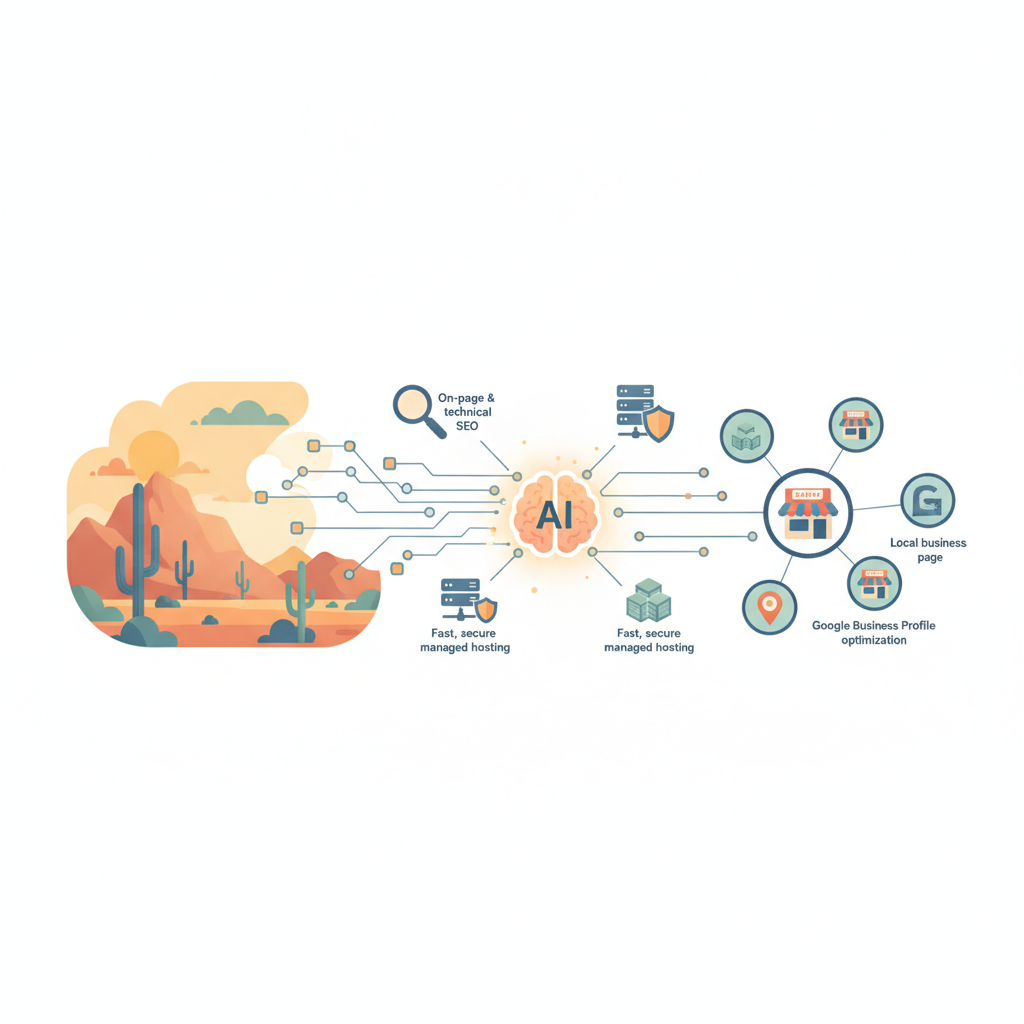
Arizona Pixel Lab approaches this as a connected system. Modern rebuilding removes technical drag. Managed hosting keeps the site stable. Our small business SEO services build the search and evidence architecture, and the technical SEO work behind it keeps the pages reachable. Local optimization aligns your business signals where local customers and AI systems look for confirmation. You do not need another pile of pages. You need a site that can prove what it says.
How can you measure your visibility in AI answers?
There is no console report that hands you an AI citation count, so measuring visibility means testing deliberately rather than waiting for a dashboard to tell you.
Four methods, in increasing order of effort:
- Run your real queries manually. Take the questions your customers actually ask — from sales calls, quote requests, and support messages — and run them in an incognito session across the engines your buyers use. Record whether you were named, whether you were linked, and which of your pages was chosen. The page that gets cited tells you which module is doing the work.
- Monitor brand mentions in generated answers. Track how often your business name appears in responses to non-branded queries. Being named without a link still moves the buyer, and it is an early sign the strategy is landing.
- Watch for the divergence pattern in Search Console. A query where your ranking holds steady but clicks fall is usually a query where a summary now resolves the question on the results page. That tells you to make the passage more quotable and the destination page more worth visiting.
- Tie it back to outcomes. Calls, form fills, and quote requests per landing page are the only numbers that settle an argument. A citation that produces nothing is a vanity metric wearing a new outfit.
Be sceptical of any tool selling you a precise "AI share of voice." Those figures are estimates built on sampled prompts, and the sampling is the whole result. Your own query list, run consistently, is more honest and more useful.
What should you do before trying to earn AI citations?
You should audit your highest-intent pages for unsupported claims, weak entity signals, missing local details, and passages that fail to answer a complete buyer question. Begin with the pages that generate calls, appointments, and qualified leads. Read them as a skeptical customer and as a system looking for evidence.
Ask direct questions.
- Can someone identify the business without leaving the page?
- Does each service claim explain scope and limitations?
- Is the local relevance real?
- Are sources and policies accessible?
- Does mobile rendering preserve the answer?
- Is the strongest information visible in a concise passage rather than trapped in an image, accordion, or sales pitch?
Fix the foundation before publishing more content. If you would rather not grade your own homework, our free SEO audit reads those pages for exactly this — unsupported claims, weak entity signals, missing local detail — and returns a prioritized list rather than a score. Then use a transparent monthly plan to keep improving the pages, proof, speed, and local signals that matter. Contact Arizona Pixel Lab — based in Gilbert, serving the East Valley — to rebuild your site into a citation-ready growth asset.
Frequently asked questions
What exactly is E-E-A-T?
E-E-A-T stands for Experience, Expertise, Authoritativeness, and Trustworthiness. It is the framework in Google's Search Quality Rater Guidelines, used by the human raters whose judgments help Google check whether its systems are surfacing reliable content.
Is E-E-A-T a direct ranking factor?
No. E-E-A-T is not a measurable ranking input you can optimise like a keyword. It is the evaluation framework behind the human quality ratings Google uses to check its own systems, which is why the signals it describes still shape what gets ranked and quoted.
How is Experience different from Expertise in E-E-A-T?
Experience is firsthand, real-world involvement — actually performing the service or using the product. Expertise is learned knowledge and credentials. A mechanic has experience fixing a car; an automotive engineer has expertise in its design. Strong pages usually show both.
Can a small local business build enough E-E-A-T to be cited?
Yes, by going narrow rather than broad. A local business builds credible authority through detailed local service documentation, genuine customer evidence, and content that demonstrates real knowledge of local conditions — none of which requires a national brand budget.
How long does it take to improve E-E-A-T signals?
Technical and on-page fixes land quickly. Building genuine authoritativeness through documented work, original findings, and earned references is an ongoing process that typically takes months to change how often you are cited.
What are eeat ai citations?
Eeat ai citations are references AI answer systems make to content that demonstrates Experience, Expertise, Authoritativeness, and Trustworthiness through clear claims, attributable sources, and verifiable evidence.
Does ranking first in Google guarantee an AI Overview citation?
No. Being cited and ranking well are related but separate outcomes — an answer engine is selecting a passage it can quote safely, not simply reading down the results page. A high rank helps, but it does not make your content quotable on its own.
What makes a local business page citation-ready?
A citation-ready local page gives a direct answer about a real service area, identifies the business clearly, supplies evidence for its claims, includes consistent contact details, and uses readable mobile-first page structure.
Is AI-written content bad for E-E-A-T?
AI-written content is not inherently bad for E-E-A-T, but scaled low-value AI content can be rated Lowest Quality under Google’s quality guidance. Human review, original experience, factual validation, and useful evidence are mandatory.
Why does third-party validation matter for AI citations?
Third-party validation gives AI systems independent reasons to trust a business claim rather than relying only on self-published marketing. Earned mentions, credible references, and original research can strengthen authority when they are relevant and accurate.
About the author
Sean Fairchild — Co Founder - CTO
Is your website winning, or quietly leaking?
Tick every box that is honestly true of your site today. Whatever you cannot tick is what we would fix first.
Your site is likely losing leads you already paid for.
Most of these gaps are invisible until you measure them, and every one of them sends high-intent visitors back to the search results. The good news: they are all fixable, and usually fast.
No jargon, no contracts. Just a straight answer.